What we found
- Lasting health problems affected the lungs, brain and nervous system, heart, kidneys and gut, as well as mental health and metabolism.
- People who had COVID-19 faced higher risks of death and new health problems, and used more health care and medicines.
- The burden grew with the severity of the initial infection, but it was present even in people who had not been hospitalized for COVID-19.
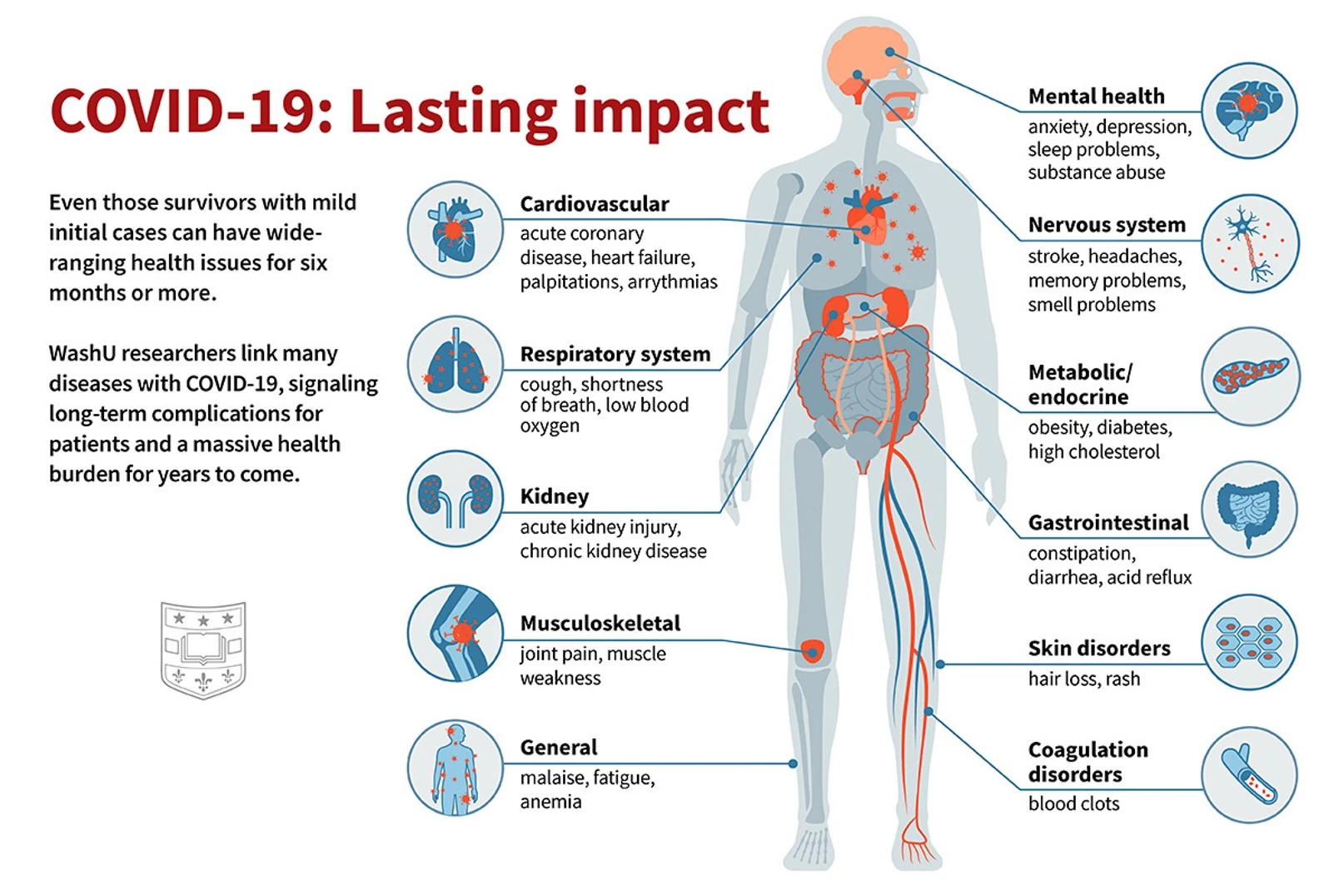
Text description of the historical graphic
The historical graphic groups reported health effects into cardiovascular, respiratory, kidney, musculoskeletal, mental health, nervous-system, metabolic/endocrine, gastrointestinal, skin, coagulation, and general categories. Examples include fatigue, shortness of breath, memory problems, and blood clots.
How we studied it
We compared 73,435 people who survived COVID-19 without hospitalization with 4,990,835 controls. We assessed outcomes from day 30 through six months and made separate comparisons involving hospitalized patients.
What it means
Long COVID is a multisystem illness. Care and research need to reach beyond the lungs and beyond the initial infection.
Study context
These were early-pandemic infections in a predominantly older, male veteran population. Later work examined how the burden changed with vaccination and new variants.
Research in use
CDC cited this study among the research used to select the conditions examined in its 2022 analysis of post-COVID illness.
The paper
High-dimensional characterization of post-acute sequelae of COVID-19.
Ziyad Al-Aly, Yan Xie, Benjamin Bowe